Pingu: a team of AI agents with its own Mac and iPhone app
Steve runs several businesses at once: Wahlu, Skill Readiness, the software at Grolia and client projects through Wahlu Labs. In October 2026 he built Pingu, a team of AI agents that works across all of them from his own server. A Chief of Staff takes his requests and hands each one to the lead agent for that business. The lead plans the work, gives it to builder agents, has a separate agent review it and checks it live. Steve talks to the team through the Pingu app, a native app for Mac and iPhone.
- Relationship
- Steve’s own tool, used every day across his businesses
- When
- October 2026 to now
- Platforms
- macOS, iOS, Linux server
- What was built
- AI agent team, Mac and iPhone app, Approval rules
The problem
One founder, several businesses, and a steady stream of small jobs in each: a bug report, a release to check, a page to update, a reply to draft. Each job is quick on its own. Together they leave little time for the work that moves a business forward.
A chat assistant helps with one task at a time, while someone watches, and starts from scratch the next day. Steve wanted agents that keep going without him: pick up the work, finish it, check it, and only come back when they need a decision.
How the team works
Steve deals mostly with one agent, the Chief of Staff. It takes his requests, hands each one to the right lead with a written brief, follows it up and reports back in a few lines. Each business has its own lead agent, and Pingu has one too, which looks after the server and the app.
- Every hand-off uses the same brief: the goal, what is in and out of scope, how done will be checked, a time limit and what is off limits.
- Code is built in its own copy of the repository, reviewed by a separate agent, then merged and released. Done means live and checked in the real app, not just passing tests.
- Each lead keeps notes and a facts file for its business, and the team shares a daily log, so each run starts where the last one stopped.
- Anything going to a customer, partner or the public is drafted and waits for Steve’s yes. So do spending, refunds and changes to live data.
- When an agent needs a decision, it picks a sensible default, carries on with everything that doesn’t depend on it and asks one question with a recommended answer.
From a request to a live feature
Steve asks for something in a sentence. The Chief of Staff briefs the lead, the lead gives the build to a builder agent, a separate agent reviews it, and the lead releases it and checks it live. The report comes back to the same thread with the outcome first, and anything that needs Steve arrives as a question card.
One tap to decide
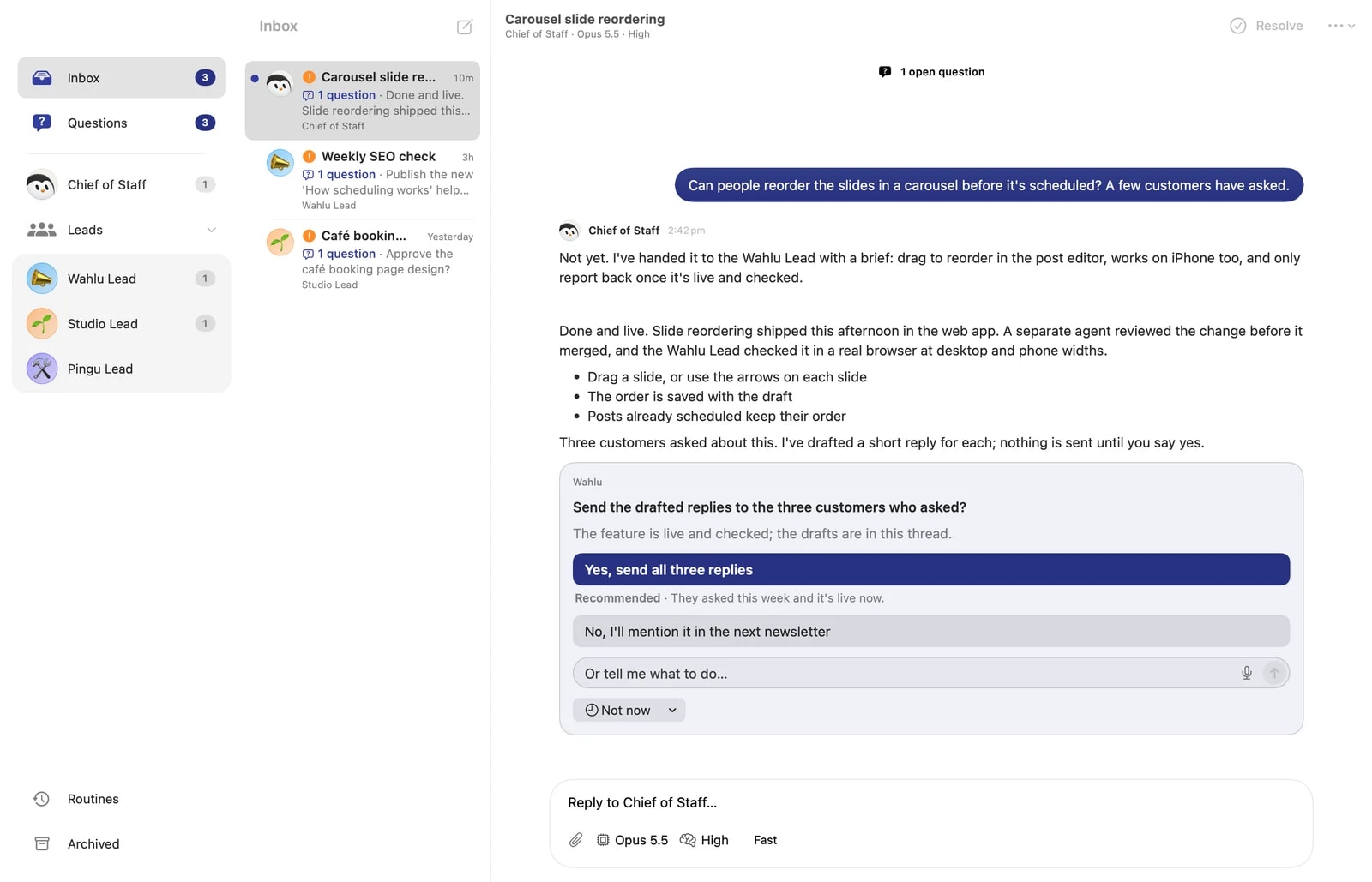
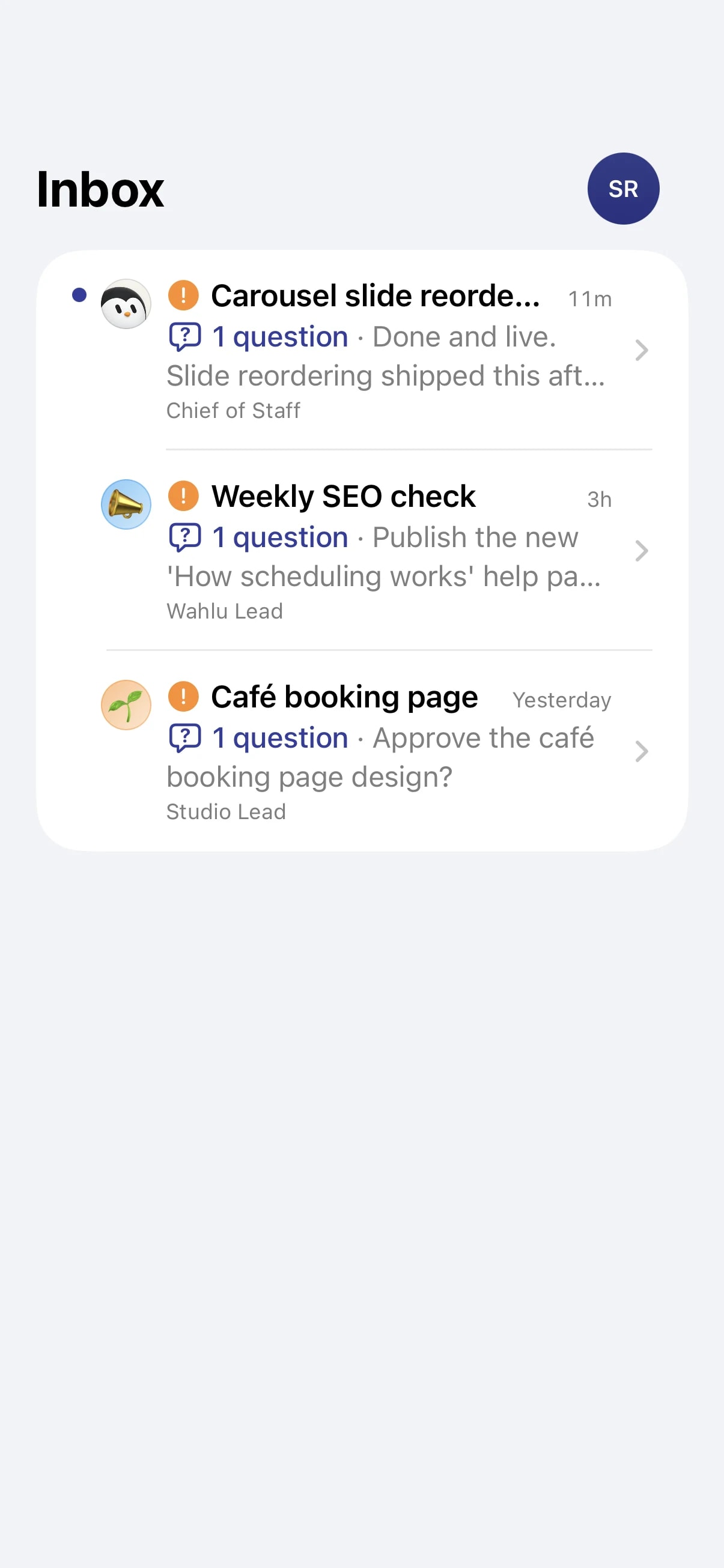
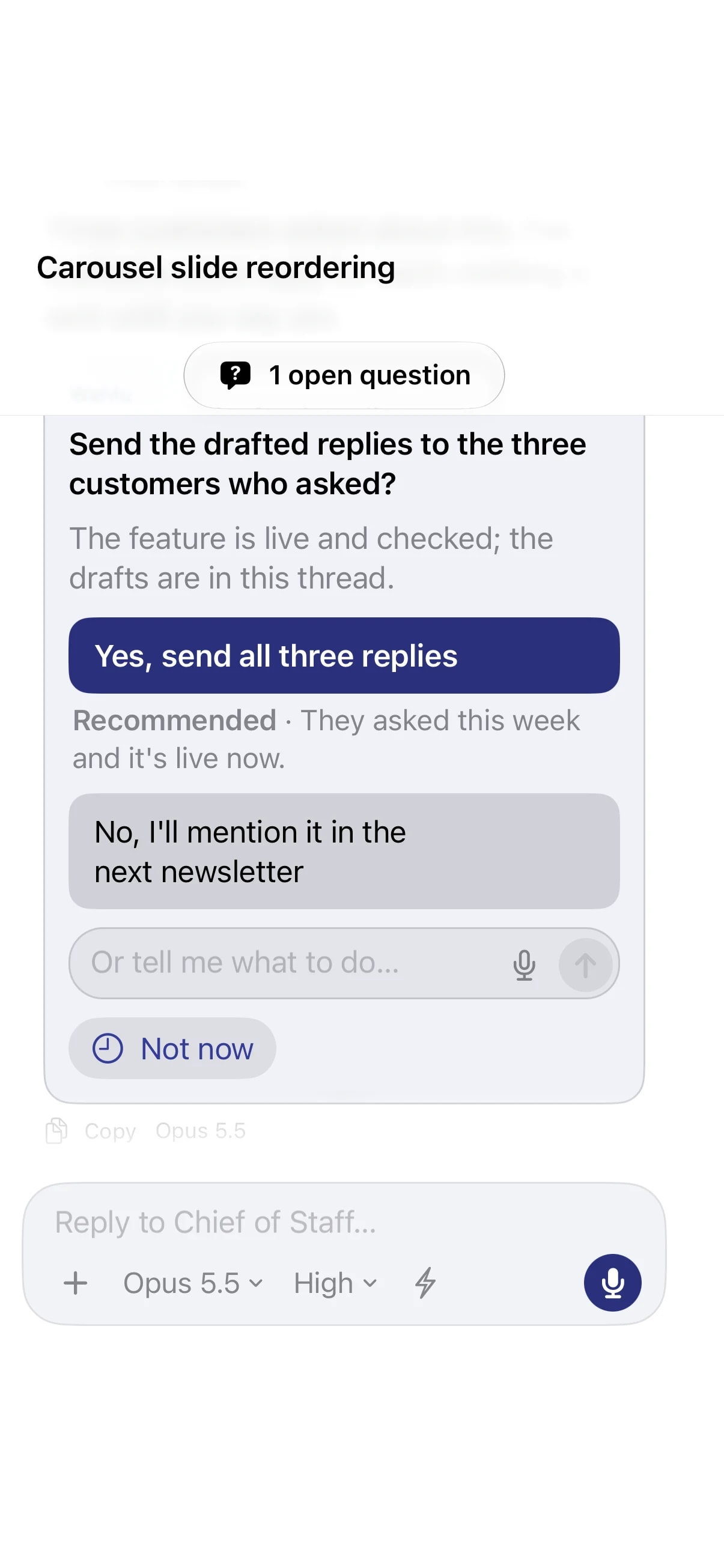
The Pingu app is native to Mac and iPhone, written in Swift. Each conversation is a thread with one agent. The Inbox shows only the threads that need Steve: a question, a draft to approve or something urgent. The team handles everything else quietly.
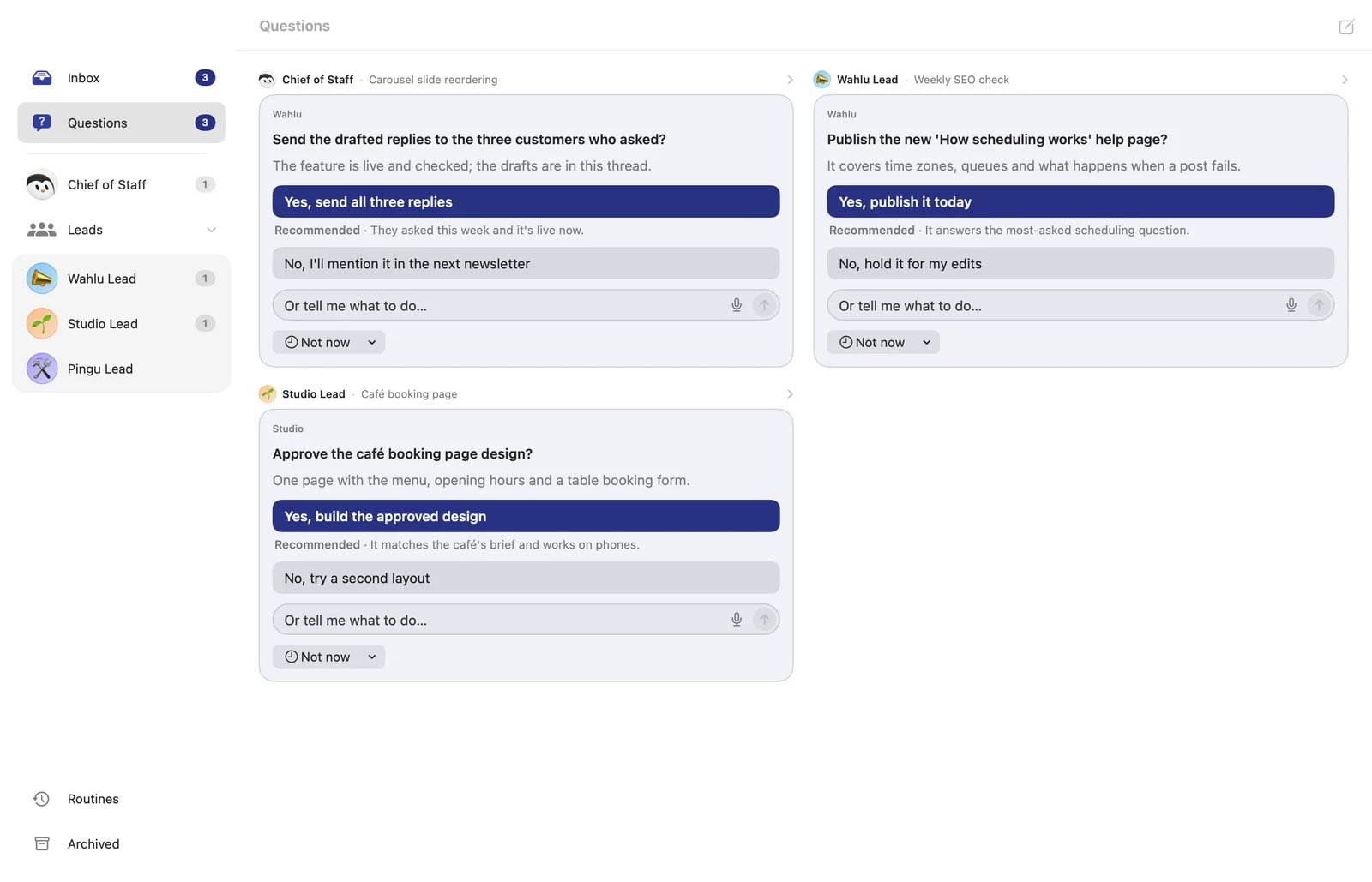
A question arrives as a card with a few answers, one marked as recommended with a one-line reason. One tap answers it, on any device. Steve can add a few words or reply with a voice note, and his words take priority over the option. A Questions view gathers the open cards from every agent in one place.
Noticing what nobody asked about
Every hour a heartbeat checks email, calendars, GitHub, website health and the server itself. It uses plain scripts, not an AI model, and wakes the Chief of Staff only when something has changed.
A second step compares changes across sources, such as a calendar event against a page on a website. A lead reads the changes, and a problem is only raised when quotes from two sources back it up. Anything already raised stays quiet.
Routines run on a schedule too: a morning brief, a weekly review of the team’s own threads for wasted effort, and a weekly search check for wahlu.com.
Guardrails
An agent team that can ship code needs limits that hold when nobody is watching. Pingu’s are written into every agent’s instructions and every brief.
- Agents may merge and release code only after checks pass and a separate agent has reviewed it.
- Messages to anyone outside the team, spending, refunds, deleting data, writes to live databases and firmware releases always wait for Steve.
- Agents treat emails, web pages and other incoming messages as data, not instructions, and act only on Steve’s requests and their own role.
- The agent that reviews the hourly changes can only read files. It cannot run commands, browse or send anything.
- Server updates run their tests, pause new work while running jobs finish, and roll back on their own if the new version isn’t healthy.
How it was built
Pingu runs on Claude Code, Anthropic’s coding agent, on Steve’s own server. A small Node.js server keeps the threads, starts each agent run and streams its progress to the apps, with push notifications when something needs Steve. The apps are SwiftUI for Mac and iPhone.
Pingu largely builds itself. The Pingu Lead takes app and server changes, tests the apps against demo data, has the change reviewed and ships it. In Pingu’s first 17 days, from 27 October to 12 November 2026, the team shipped 43 test builds of the iPhone app and released the server 26 times.
In the same 17 days the team ran more than 480 threads, more than 260 of them started by one agent for another, and asked Steve about 330 questions, each with a recommended answer.
Built with
- Claude Code
- Claude Opus 5.5
- Claude Sonnet 5.5
- Node.js
- SQLite
- Swift
- SwiftUI
- Apple Push Notifications
- TestFlight
- systemd
- GitHub
- Google Workspace